Wednesday, 12 December 2012

Wednesday, 27 June 2012
Autobiography of a Nobody
I have taken a bit of a break from blogging over the last few months, mainly to get this book finished, and also work on the next one. I know this book is not strictly about horses but there is quite a bit of horse stuff in it.
www.lulu.com/shop/tom-widdicombe/autobiography-of-a-nobody/paperback/product-20178872.html

If you have enjoyed reading my other books or my blogs you may enjoy this one too.
Kind Regards
Tom
www.lulu.com/shop/tom-widdicombe/autobiography-of-a-nobody/paperback/product-20178872.html
If you have enjoyed reading my other books or my blogs you may enjoy this one too.
Kind Regards
Tom
Sunday, 8 April 2012
Interview with Annie - Number 3 – January 2012
Annie - Hi Tom
Tom – Hi Annie, is it that time of year already!
Annie – Yes it is. It soon goes by doesn’t it!
Tom – So shall we get straight on with the interview or do you want to have a coffee first?
Sarah – I’ll tell you what, you get on with the interview and I’ll make the coffee. How does that sound?
Tom – That sounds good to me.
Annie – So Tom, I’ve heard on the grapevine that you have packed in teaching horsemanship. Is that true?
Tom – Well yes it is, so shall we end the interview right now.
Annie – Well, I’d like to carry on if you are happy to talk about it. I’m intrigued to know why you’ve quit. Did you suddenly decide or has it been coming on for a while?
Tom – Well, I didn’t feel comfortable teaching for a couple of years really. And then we were learning a lot of new stuff ourselves. Big stuff that was causing us to almost completely change some fundamentals of the way we were working. Sometimes I would be teaching and I would be feeling like I was almost making it up as I was going along. I know I’ve always slightly had that feeling anyway, which I think you are bound to do really if you are constantly learning yourself, which of course is what you should be doing anyway.
Annie – Yes, but if you realise you are always slightly operating in new territory and have always been doing that anyway, why the sudden change?
Tom – Well Annie, I just got tired of watching people going around in circles.
Annie – What, you mean you are tired of schooling horses?
Tom – No, no, no, not that kind of going around in circles. I got tired of telling people the same thing over and over again. I kind of got to a point where I thought, you know, either listen to what I am saying or don’t keep asking my advice. It sounds terribly intolerant I know, but it does get very trying sometimes on that front.
Annie – Well, give me an example of the kind of thing that would annoy you then.
Tom – Ok, well you know where my strengths are in horsemanship don’t you. Well I think I know anyway. I am reasonably good at the basics, and I actually think if you don’t understand and implement the basics into your horsemanship you are never really going to have a happy horse and get good results with the work that you want to do.
It’s simple stuff but for some reason, and I’ll say here straight out, mostly the reasons are that some people have unreal ideas about what horses are, what horses need from people, and what people need from horses. While people are fiddling around trying to manifest unrealistic dreams between them and their horse, well, I can’t get involved in that stuff. It’s the basics, the fundamentals, the simple stuff like the horse just knowing and understanding what it is you want, and vice versa. I don’t know how to say it simpler than that really.
Annie – Well ok, can you give me some examples of confusion that people take to their horses.
Tom – Well I can, but whether I should I’m not so sure. People are very sensitive about this kind of thing. I kind of came to the conclusion that I’d quietly leave the scene and let people sort it out for themselves, if they wanted to.
Annie – Well I’ve heard you say that now you are old you don’t care, so go on, just say it. What’s the worst that can happen.
Tom – Well, the worst that can happen is that the internet goes mental and my wife’s business completely ditches because of my big mouth. But yes, sometimes I do think someone needs to stand up and say ‘for god’s sake, stop treating horses as if they are humans’. I mean it has to be one of the most ugly things you can ever see doesn’t it - people feeding titbits to their horse for every little try. I mean why! Anybody can see that a good horseman can get their horse to quite happily try and do anything without a titbit, so why do people do it. I’ll tell you why, two reasons, because the person doesn’t understand the mind of the horse, and for some weird reason thinks that the horse will work better if it’s fed carrots every few seconds. And secondly, people think they can short cut good horsemanship by using tricks. Well, they can’t. They think that the horse’s mind works like the human mind, or maybe they want it to be that way.
To be honest it’s the same with humans. If you can free up the human mind from the need to be constantly rewarded then he will work better too, so they are wrong there too.
Annie – Well, now you’ve done it haven’t you. You’ve just lost all your clients by speaking your mind.
Tom – Yep, that’s it. Now even if I wanted to teach there wouldn’t be anyone to teach. Ah well, so now I have finally retired. Can you not come round here again Annie.
Annie – OK Tom, so we’ll make this the final interview. I was hoping to get enough to make a book out of it but never mind. It’s quite fun hearing you get all fired up about this stuff. So now let’s get back to the big changes in your horsemanship over the last few years.
Tom – Yes Ok, it’s actually very interesting because we arrived at a point where we realised we needed to be much more proactive to help to get the horse to operate in a way that is mentally and physically beneficial to itself. We realised that what we wanted to achieve wasn’t just going to happen by what you might call ‘good fundamentals of horsemanship’.
Annie – So before that you thought that everything would sort itself out if you got the basics right?
Tom – Yes, although I am sure some people would be thinking that what we are doing now is the basics. But actually, we arrived at a point where we could see that what we needed to happen couldn’t just happen as a bi-product of good horsemanship. We needed to get in there and help the horse find the correct way of doing things.
Annie – I think an example would help me understand what you are talking about here.
Tom – OK, well you can see that most if not every horse favours one side over another, much the same way as we are either right or left handed. So an example of this might be that the horse always prefers to put his weight on to one front foot rather than the other, and because of this he finds that going one way is easier than going the other way. In fact this can become so extreme that some horses can only go one way around a circle.
So we can teach the horse to even up his weight onto his two front feet and get him to practise going in this balanced way. He can then take this balance through to the point where he begins to even up both ways. Now I know this is a simple example and this may sound obvious to you, but I can tell you that loads of riders have their horses going around and around trying to get them to even up both ways, but in fact what they are doing is have their horse going around practising how not to do it right. Instead of helping the horse get better they help the horse get worse. If you find yourself practising what you don’t want, you need to change things around straightaway. But if you don’t know how to do that, and your horse certainly won’t know, then you are in trouble.
Annie – So are you saying that the horse won’t naturally put itself right no matter how much softness you have going between you.
Tom – Well yes I am really. I know of some really good trainers who do believe it will all work out, but I’d just say here, why make it hard for yourself, and the horse. It’s actually very easy to get in there and straighten your horse up.
Annie – That’s interesting.
Tom – And here is another thing. Most horses won’t naturally carry their rider in the correct weight bearing posture, nor will they understand front to back balance. Some will. Some have been bred to be that way, but actually if you personally aren’t aware of these things it won’t take you long to knock that out of even them.
Annie – Weight bearing posture and front to back balance – did you mention that last time.
Tom – Dunno, maybe. But the fact is you need to teach your horse to lift himself up at the front, and to be in balance. Now there’s no way on earth he is going to sort that out for himself. He has no idea he needs to do that. But once you understand what it means and how to do it, it’s not that difficult really.
Annie – Actually I’ve watched you and Sarah doing this work. It almost looks like the horse enjoys it, wouldn’t you say.
Tom – For sure I agree with that. It puts the horse and rider together in the moment. It feels good for the horse and for you. You know, I’ll tell you one more thing here too. You hear a lot of people using the word balance. I think they must think balance is just, ‘not falling over’ or something. The fact is that if you are using restrictive tack, or you have trained into your horse some muscular tension, say for example your horse is pulling back away from the bit, or leaning on the bit even, or you are using or holding muscular tension in yourself to manufacture the movement of your horse, then you and the horse can’t truly be in balance. You might be still standing up, and you might be still going along, but you are not ‘in balance’, not in the sense that without physical force you could both move as a unit in any direction. Actually, now I’ve said that I can see that it should be described more as ‘at a point of balance’ - that makes more sense.
Think about how much effort it takes… no, I’ll tell you what, let’s do it this way. Let’s balance this coin on its edge. Now, how much effort does it take to knock it over. Virtually none, and that is because it is in balance. That is how it feels when you ride a horse in balance – it should be effortless.
Annie – Wow, I’m starting to get a picture of what you are talking about there. Blimey, it does seem a bit silly to get all this sorted out and then to give up teaching.
Tom – Well, not really, not from my point of view anyway. There’s some good teachers out there – way better than me – and certainly way better riders too, and anyway, I’ve got a bit of a bee in my bonnet about teaching at the moment too (laughs out loud). Do you think I should get some therapy?
Annie – Ha hah hah, well, I’ve always thought that. But anyway, what’s your problem with teaching?
Tom – Well, I think the teacher/student thing can really prevent the freedom that you as a person need to learn. I get tired of people relying on their teacher. How many times have I heard people say, ‘Ah I must ask so and so about that’. I just want to say, ‘For gods sake, get yourself to the point where you can work it out for yourself. Get to the point where you aren’t scared of making mistakes and learning from them. Get beyond needing the security of a teacher to look after you. Then you will start to learn for yourself. You’ll start the real learning’.
Annie – But surely there is no need to re-invent the wheel. Your teacher can save you a lot of time and effort can’t he.
Tom – No, not really. The thing is I can tell you something but until you actually understand it for real, not just in theory, then you don’t know it. So even if hundreds of good horsemen have worked this out before us, which they have, we still have to work it out for ourselves when we get to it. You aren’t re-inventing the wheel – you are discovering good horsemanship.
Annie – Wow, we’ve covered a lot of ground there in a very short time haven’t we. I still think it’s a shame you’ve quit though.
Tom – Well, not really Annie. Like I say there’s more knowledgeable people than me out there, and to be honest I’ve got plenty of other things to do at the moment anyway.
Annie – Ok then Tom, well, thanks for the interview. How’s about I come back in a year and see how it’s going.
Tom – Yep ok then Annie. And what are you up to anyway – you can’t still be a student.
Annie – No I’m not. I’m doing quite a bit of freelance stuff at the moment. Gonna go and see if I can sell this interview now…..
Tom – Ha hah hah, you’ll be lucky!
Tom – Hi Annie, is it that time of year already!
Annie – Yes it is. It soon goes by doesn’t it!
Tom – So shall we get straight on with the interview or do you want to have a coffee first?
Sarah – I’ll tell you what, you get on with the interview and I’ll make the coffee. How does that sound?
Tom – That sounds good to me.
Annie – So Tom, I’ve heard on the grapevine that you have packed in teaching horsemanship. Is that true?
Tom – Well yes it is, so shall we end the interview right now.
Annie – Well, I’d like to carry on if you are happy to talk about it. I’m intrigued to know why you’ve quit. Did you suddenly decide or has it been coming on for a while?
Tom – Well, I didn’t feel comfortable teaching for a couple of years really. And then we were learning a lot of new stuff ourselves. Big stuff that was causing us to almost completely change some fundamentals of the way we were working. Sometimes I would be teaching and I would be feeling like I was almost making it up as I was going along. I know I’ve always slightly had that feeling anyway, which I think you are bound to do really if you are constantly learning yourself, which of course is what you should be doing anyway.
Annie – Yes, but if you realise you are always slightly operating in new territory and have always been doing that anyway, why the sudden change?
Tom – Well Annie, I just got tired of watching people going around in circles.
Annie – What, you mean you are tired of schooling horses?
Tom – No, no, no, not that kind of going around in circles. I got tired of telling people the same thing over and over again. I kind of got to a point where I thought, you know, either listen to what I am saying or don’t keep asking my advice. It sounds terribly intolerant I know, but it does get very trying sometimes on that front.
Annie – Well, give me an example of the kind of thing that would annoy you then.
Tom – Ok, well you know where my strengths are in horsemanship don’t you. Well I think I know anyway. I am reasonably good at the basics, and I actually think if you don’t understand and implement the basics into your horsemanship you are never really going to have a happy horse and get good results with the work that you want to do.
It’s simple stuff but for some reason, and I’ll say here straight out, mostly the reasons are that some people have unreal ideas about what horses are, what horses need from people, and what people need from horses. While people are fiddling around trying to manifest unrealistic dreams between them and their horse, well, I can’t get involved in that stuff. It’s the basics, the fundamentals, the simple stuff like the horse just knowing and understanding what it is you want, and vice versa. I don’t know how to say it simpler than that really.
Annie – Well ok, can you give me some examples of confusion that people take to their horses.
Tom – Well I can, but whether I should I’m not so sure. People are very sensitive about this kind of thing. I kind of came to the conclusion that I’d quietly leave the scene and let people sort it out for themselves, if they wanted to.
Annie – Well I’ve heard you say that now you are old you don’t care, so go on, just say it. What’s the worst that can happen.
Tom – Well, the worst that can happen is that the internet goes mental and my wife’s business completely ditches because of my big mouth. But yes, sometimes I do think someone needs to stand up and say ‘for god’s sake, stop treating horses as if they are humans’. I mean it has to be one of the most ugly things you can ever see doesn’t it - people feeding titbits to their horse for every little try. I mean why! Anybody can see that a good horseman can get their horse to quite happily try and do anything without a titbit, so why do people do it. I’ll tell you why, two reasons, because the person doesn’t understand the mind of the horse, and for some weird reason thinks that the horse will work better if it’s fed carrots every few seconds. And secondly, people think they can short cut good horsemanship by using tricks. Well, they can’t. They think that the horse’s mind works like the human mind, or maybe they want it to be that way.
To be honest it’s the same with humans. If you can free up the human mind from the need to be constantly rewarded then he will work better too, so they are wrong there too.
Annie – Well, now you’ve done it haven’t you. You’ve just lost all your clients by speaking your mind.
Tom – Yep, that’s it. Now even if I wanted to teach there wouldn’t be anyone to teach. Ah well, so now I have finally retired. Can you not come round here again Annie.
Annie – OK Tom, so we’ll make this the final interview. I was hoping to get enough to make a book out of it but never mind. It’s quite fun hearing you get all fired up about this stuff. So now let’s get back to the big changes in your horsemanship over the last few years.
Tom – Yes Ok, it’s actually very interesting because we arrived at a point where we realised we needed to be much more proactive to help to get the horse to operate in a way that is mentally and physically beneficial to itself. We realised that what we wanted to achieve wasn’t just going to happen by what you might call ‘good fundamentals of horsemanship’.
Annie – So before that you thought that everything would sort itself out if you got the basics right?
Tom – Yes, although I am sure some people would be thinking that what we are doing now is the basics. But actually, we arrived at a point where we could see that what we needed to happen couldn’t just happen as a bi-product of good horsemanship. We needed to get in there and help the horse find the correct way of doing things.
Annie – I think an example would help me understand what you are talking about here.
Tom – OK, well you can see that most if not every horse favours one side over another, much the same way as we are either right or left handed. So an example of this might be that the horse always prefers to put his weight on to one front foot rather than the other, and because of this he finds that going one way is easier than going the other way. In fact this can become so extreme that some horses can only go one way around a circle.
So we can teach the horse to even up his weight onto his two front feet and get him to practise going in this balanced way. He can then take this balance through to the point where he begins to even up both ways. Now I know this is a simple example and this may sound obvious to you, but I can tell you that loads of riders have their horses going around and around trying to get them to even up both ways, but in fact what they are doing is have their horse going around practising how not to do it right. Instead of helping the horse get better they help the horse get worse. If you find yourself practising what you don’t want, you need to change things around straightaway. But if you don’t know how to do that, and your horse certainly won’t know, then you are in trouble.
Annie – So are you saying that the horse won’t naturally put itself right no matter how much softness you have going between you.
Tom – Well yes I am really. I know of some really good trainers who do believe it will all work out, but I’d just say here, why make it hard for yourself, and the horse. It’s actually very easy to get in there and straighten your horse up.
Annie – That’s interesting.
Tom – And here is another thing. Most horses won’t naturally carry their rider in the correct weight bearing posture, nor will they understand front to back balance. Some will. Some have been bred to be that way, but actually if you personally aren’t aware of these things it won’t take you long to knock that out of even them.
Annie – Weight bearing posture and front to back balance – did you mention that last time.
Tom – Dunno, maybe. But the fact is you need to teach your horse to lift himself up at the front, and to be in balance. Now there’s no way on earth he is going to sort that out for himself. He has no idea he needs to do that. But once you understand what it means and how to do it, it’s not that difficult really.
Annie – Actually I’ve watched you and Sarah doing this work. It almost looks like the horse enjoys it, wouldn’t you say.
Tom – For sure I agree with that. It puts the horse and rider together in the moment. It feels good for the horse and for you. You know, I’ll tell you one more thing here too. You hear a lot of people using the word balance. I think they must think balance is just, ‘not falling over’ or something. The fact is that if you are using restrictive tack, or you have trained into your horse some muscular tension, say for example your horse is pulling back away from the bit, or leaning on the bit even, or you are using or holding muscular tension in yourself to manufacture the movement of your horse, then you and the horse can’t truly be in balance. You might be still standing up, and you might be still going along, but you are not ‘in balance’, not in the sense that without physical force you could both move as a unit in any direction. Actually, now I’ve said that I can see that it should be described more as ‘at a point of balance’ - that makes more sense.
Think about how much effort it takes… no, I’ll tell you what, let’s do it this way. Let’s balance this coin on its edge. Now, how much effort does it take to knock it over. Virtually none, and that is because it is in balance. That is how it feels when you ride a horse in balance – it should be effortless.
Annie – Wow, I’m starting to get a picture of what you are talking about there. Blimey, it does seem a bit silly to get all this sorted out and then to give up teaching.
Tom – Well, not really, not from my point of view anyway. There’s some good teachers out there – way better than me – and certainly way better riders too, and anyway, I’ve got a bit of a bee in my bonnet about teaching at the moment too (laughs out loud). Do you think I should get some therapy?
Annie – Ha hah hah, well, I’ve always thought that. But anyway, what’s your problem with teaching?
Tom – Well, I think the teacher/student thing can really prevent the freedom that you as a person need to learn. I get tired of people relying on their teacher. How many times have I heard people say, ‘Ah I must ask so and so about that’. I just want to say, ‘For gods sake, get yourself to the point where you can work it out for yourself. Get to the point where you aren’t scared of making mistakes and learning from them. Get beyond needing the security of a teacher to look after you. Then you will start to learn for yourself. You’ll start the real learning’.
Annie – But surely there is no need to re-invent the wheel. Your teacher can save you a lot of time and effort can’t he.
Tom – No, not really. The thing is I can tell you something but until you actually understand it for real, not just in theory, then you don’t know it. So even if hundreds of good horsemen have worked this out before us, which they have, we still have to work it out for ourselves when we get to it. You aren’t re-inventing the wheel – you are discovering good horsemanship.
Annie – Wow, we’ve covered a lot of ground there in a very short time haven’t we. I still think it’s a shame you’ve quit though.
Tom – Well, not really Annie. Like I say there’s more knowledgeable people than me out there, and to be honest I’ve got plenty of other things to do at the moment anyway.
Annie – Ok then Tom, well, thanks for the interview. How’s about I come back in a year and see how it’s going.
Tom – Yep ok then Annie. And what are you up to anyway – you can’t still be a student.
Annie – No I’m not. I’m doing quite a bit of freelance stuff at the moment. Gonna go and see if I can sell this interview now…..
Tom – Ha hah hah, you’ll be lucky!
Wednesday, 6 July 2011
Ask yourself this?
Are you making progress with your horsemanship?
I am constantly amazed by the money that people hand over to trainers in return for not a lot really. If you want to employ a trainer to help you progress your horsemanship, here are some guidelines I reckon you should follow.
a) You should make tangible progress in every session.
b) You should leave with more knowledge and less confusion than you arrived with.
c) You should understand what the job is that you are trying to do.
d) Your horse should understand what the job is that you are asking him to do.
e) Your trainer should be concerned if you are not making progress.
That is some basic stuff just about your sessions – The next list is about you and your horse, and is just my opinion. I would go as far as to say that if these things aren’t happening you need to think about what you and your horse are actually learning in your training sessions.
a) You should be learning to relax on your horse.
b) Your horse should be learning to relax with you on board.
c) You should be training your horse without the use of force or restriction.
d) Your horse should be learning to carry you correctly.
Put in a nutshell, I guess what I am saying is if you are using any bracing in yourself, you shouldn’t be. If you are using restrictive tack you shouldn’t be. If you are pulling your horse in at the front you shouldn’t be. If your horse is over-bending he shouldn’t be. If your horse is worried about the bit he shouldn’t be. If you have a backwards pull in your hands you shouldn’t have. If your horse isn’t going forward when you ask he should be. If you are doing all the work to keep your horse going you shouldn’t be. If your horse is travelling on the front end he shouldn’t be. If your horse isn’t willing to do what you ask he should be. And finally, you should understand what riding in balance is.
If you don’t understand anything about any or all of the above you should ask your trainer to explain these things to you, and make sure that you understand his/her answer, and that you are happy with it.
I am constantly amazed by the money that people hand over to trainers in return for not a lot really. If you want to employ a trainer to help you progress your horsemanship, here are some guidelines I reckon you should follow.
a) You should make tangible progress in every session.
b) You should leave with more knowledge and less confusion than you arrived with.
c) You should understand what the job is that you are trying to do.
d) Your horse should understand what the job is that you are asking him to do.
e) Your trainer should be concerned if you are not making progress.
That is some basic stuff just about your sessions – The next list is about you and your horse, and is just my opinion. I would go as far as to say that if these things aren’t happening you need to think about what you and your horse are actually learning in your training sessions.
a) You should be learning to relax on your horse.
b) Your horse should be learning to relax with you on board.
c) You should be training your horse without the use of force or restriction.
d) Your horse should be learning to carry you correctly.
Put in a nutshell, I guess what I am saying is if you are using any bracing in yourself, you shouldn’t be. If you are using restrictive tack you shouldn’t be. If you are pulling your horse in at the front you shouldn’t be. If your horse is over-bending he shouldn’t be. If your horse is worried about the bit he shouldn’t be. If you have a backwards pull in your hands you shouldn’t have. If your horse isn’t going forward when you ask he should be. If you are doing all the work to keep your horse going you shouldn’t be. If your horse is travelling on the front end he shouldn’t be. If your horse isn’t willing to do what you ask he should be. And finally, you should understand what riding in balance is.
If you don’t understand anything about any or all of the above you should ask your trainer to explain these things to you, and make sure that you understand his/her answer, and that you are happy with it.
Monday, 2 May 2011
At last!
At last we have written down some principles.
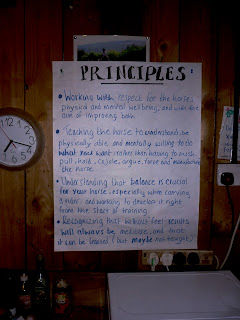
Photo taken at this weekend's clinic
Working with respect for the horse’s physical and mental well-being, and with the aim of improving both.
Teaching the horse to understand, be physically able and mentally willing to do what you want, rather than the rider having to push, hold, cajole, argue, force and ‘manufacture’ the horse.
Understanding that balance is crucial for your horse, especially when carrying a rider, and working to develop it right from the start of training.
Recognizing that without ‘feel’ results will always be mediocre, and that it can be learned (but maybe not taught).
Saturday, 23 April 2011
The two ways to train horses.
Surely there must be more than two ways to train a horse. Well, I don't think there are. You either train the horse to accept restriction or you train it to work in freedom. You might think that there is a spectrum between those two extremes, but there isn't. There is a spectrum of restriction, ranging from simply appalling to not too bad. But freedom is freedom, it isn't on a spectrum and you are either doing it or you are not.
One thing is for sure, it's quicker and easier to train a horse to accept restriction, and if you measure progress by what the horse can do, you might even begin to think that it is indeed the best way to go. Walk, trot, canter, hack, hunt, jump, or even do some fancy moves. You can get your horse to do all this pretty quickly by holding it in place. Once the horse has accepted the pressure of the bit in his mouth, and the power of the riders hands and legs, then all he has to do is surrender and go wherever he is pulled or pushed.
I guess it is fairly obvious that I don't like that system of training very much. I can see it suits some people's needs, but the thing is it's not very good really, is it? The horses might be doing a semblance of the job, but there is always something wrong with how it's being done. Because of the restrictions the horse has no natural balance, so his movements are always, at best, going to be slightly wrong. I mean, think about it, if you take away all the physical support from the rider and the tack, could the horse still do all that stuff. Let's face it, he wouldn't have a clue. The restricted horse is trained to accept the movements that the rider physically makes him do.
To sit on a horse that understands to travel in balance, and happily moves to the smallest ask - now that's what I call a nicely trained horse. And producing a horse like that, now that's what I call good horse training.

Thursday, 31 March 2011
So what is dressage?
So what is dressage? Is it that ghastly stuff you see where people pull their horses around using severely restricting equipment? Is it forcing your horse into a shape that you saw in a book, but at the same time having no idea why you are doing it? Is it doing fancy moves to show off to your friends? Is it a competition? Is it honing your riding skills to such a degree that you can manufacture the horse that you want? If you think it is any of the above I have to say straight out, for the sake of the horse, I disagree with you. So what is it then? Well, I’m pretty sure it’s exercises to help your horse travel straight and in balance. This is important stuff to a horse, physically and mentally. Straightness and balance make horses feel good. But it’s not something you can force on the horse. You have to train the horse himself to maintain the correct way of going. So if you are using your tack or your seat or your arms or your legs to keep your horse on track, then the job isn’t done. People may think you are a good rider, and you might be too, but the truth is you are manufacturing the horse. Our 2011 clinic plans are now up. http://bewithyourhorse.com/about-our-clinics/
Monday, 29 November 2010
Welcome
Hi.
Thanks for visiting my horse blog. I am taking a break from the blog for a while as I have another project on. If this is your first visit please feel free to read and hopefully enjoy previous posts.
Kind Regards
Tom
Thanks for visiting my horse blog. I am taking a break from the blog for a while as I have another project on. If this is your first visit please feel free to read and hopefully enjoy previous posts.
Kind Regards
Tom
Saturday, 6 November 2010
Is horsemanship a marshall art?
I was thinking about horsemanship, and how learning it is a bit like learning a marshall art. Not that I've ever learnt one of those, but I have heard people talking about it. Practising the move until it's perfect, done in relaxation and without thought - that's how I want to be with my horse.
There are a few basic things that I am working on with my horse at the moment. They are feel, balance, relaxation, co-ordination, and knowledge of the horse and how it moves, and that's about it for me really. At times I have focussed in on any one of these things and thought it was all there was to know about horses, but now I reckon it's all of them that I need to study, understand and work on.
I was watching a girl ride my horse the other day. She was riding him nicely. She is a more experienced rider than me and in some ways it shows. But there were one or two things that I saw there that have prompted me to write this post. I work a lot on my balance, and to be honest that showed up a bit there. When my friend was moving my horse through the shoulder in walk she couldn't get as sharp of a turn as I get. So why was that - same horse after all. I thought about this for a while and then decided that the more you work on feel and balance the more control you and your horse have in situations like that. The difference in weight change front to back might be tiny, but it makes all the difference to how sharp you could make that turn. Right there I'd better say that I want to do this whole thing with no force - just feel - no pulling or pushing ok.
That skill, learning to balance, is something to practice. I am at the beginning of it. Combining it with a nice feel through your body and through your hands - well, I think that is what I need to practise over and over to get the improvement in my horsemanship that I want to see.
So to get a nice feel - well, that's about being able to relax on my horse. I notice that when things get a bit difficult, that is when I tighten up. So I practice making a move and staying relaxed. I have heard people talk about a good seat. No idea what that means myself, but I have worked hard on relaxing in the saddle. Tension and balance struggle to exist together. I know the bits of me that tense up and I am consciously working on ironing them out. If you get on a tricky horse that struggles with a move, say even a simple move like a back up, that's a good time to see what your body does when things are a bit difficult. When your horse floats back like a good un, well, it's pretty easy to relax with that.
Co-ordination and knowledge of the horse's way of going - those are things that I would have chosen to ignore in my past. But now I can see the need. I have to know what affects what, and how the horse needs to travel (I don't mean he needs to take a little road trip - I mean the way he goes best). It's not rocket science - well it might be, but at my level it's not. The fact is the way you use your hands can have a huge effect, so it's important. An example might be if you are asking your horse to bend and you put a slightly backwards and outwards feel into your rein you may well get a lurch to that side. If you put a slightly backwards and inwards feel in the rein you might get a sideways twist in your horses neck. If you put a really nice small upwards feel, neither backwards, outwards or inwards, you will have more of a chance of getting a nice clean little bend.
All these things are quite small points to work on. But that seems to be what it's coming down to for me. I'm quite pleased really. I'd hate it if horsemanship had turned out to be some crap thing where you have to tie your horse down and pull him around all over the place. There's a lot of people still doing that though, aren't there!
There are a few basic things that I am working on with my horse at the moment. They are feel, balance, relaxation, co-ordination, and knowledge of the horse and how it moves, and that's about it for me really. At times I have focussed in on any one of these things and thought it was all there was to know about horses, but now I reckon it's all of them that I need to study, understand and work on.
I was watching a girl ride my horse the other day. She was riding him nicely. She is a more experienced rider than me and in some ways it shows. But there were one or two things that I saw there that have prompted me to write this post. I work a lot on my balance, and to be honest that showed up a bit there. When my friend was moving my horse through the shoulder in walk she couldn't get as sharp of a turn as I get. So why was that - same horse after all. I thought about this for a while and then decided that the more you work on feel and balance the more control you and your horse have in situations like that. The difference in weight change front to back might be tiny, but it makes all the difference to how sharp you could make that turn. Right there I'd better say that I want to do this whole thing with no force - just feel - no pulling or pushing ok.
That skill, learning to balance, is something to practice. I am at the beginning of it. Combining it with a nice feel through your body and through your hands - well, I think that is what I need to practise over and over to get the improvement in my horsemanship that I want to see.
So to get a nice feel - well, that's about being able to relax on my horse. I notice that when things get a bit difficult, that is when I tighten up. So I practice making a move and staying relaxed. I have heard people talk about a good seat. No idea what that means myself, but I have worked hard on relaxing in the saddle. Tension and balance struggle to exist together. I know the bits of me that tense up and I am consciously working on ironing them out. If you get on a tricky horse that struggles with a move, say even a simple move like a back up, that's a good time to see what your body does when things are a bit difficult. When your horse floats back like a good un, well, it's pretty easy to relax with that.
Co-ordination and knowledge of the horse's way of going - those are things that I would have chosen to ignore in my past. But now I can see the need. I have to know what affects what, and how the horse needs to travel (I don't mean he needs to take a little road trip - I mean the way he goes best). It's not rocket science - well it might be, but at my level it's not. The fact is the way you use your hands can have a huge effect, so it's important. An example might be if you are asking your horse to bend and you put a slightly backwards and outwards feel into your rein you may well get a lurch to that side. If you put a slightly backwards and inwards feel in the rein you might get a sideways twist in your horses neck. If you put a really nice small upwards feel, neither backwards, outwards or inwards, you will have more of a chance of getting a nice clean little bend.
All these things are quite small points to work on. But that seems to be what it's coming down to for me. I'm quite pleased really. I'd hate it if horsemanship had turned out to be some crap thing where you have to tie your horse down and pull him around all over the place. There's a lot of people still doing that though, aren't there!
Saturday, 16 October 2010
New interview with Annie
Annie: Hi Tom. It’s been a couple of years since we met up and chatted about horses.
Tom: Yep, it has, and it feels like a lot has happened since then.
Annie: So I’m really interested in what you have been getting up to with the horse-work. Any huge changes?
Tom: Well, I wouldn’t say ‘huge changes’ but yes, we have moved things along quite a way. I’d say all the important stuff is still in place. Working on softness and feel – you never get to the end of that job. But what we have done is made some dramatic changes to our ridden work.
Annie: Oh that’s interesting – cos you were always known as a trainer who didn’t ride much. Are you riding a lot these days?
Tom: Yeah, I do ride quite a bit. I like going out to check the cows. I’m still not a particularly accomplished rider, but I love the work we are doing now. It all makes so much sense to me. I feel like I have finally found out how to ‘be with the horse’ while I am riding him. That was always such a mystery to me – I felt like I couldn’t find the key to that one. But now I’ve got it.
Annie: Go on then, tell me.
Tom: Well, it’s simple stuff actually. I guess in a sentence I’d say, ‘get your horse in balance with you, in the moment, and you’ve got him, right there with you, and that’s it’.
Annie: That doesn’t mean much to me Tom. Explain what you mean by that?
Tom: Well, for years I heard people saying stuff like ‘get your horse off the forehand’ and I had not the slightest idea what they were on about. I presumed it was something that happens to you when you reach a level of riding skill way beyond what I was ever going to get to. I don’t really believe that anymore. I reckon most people (and horses) can get to it. And that’s what I mean by balance. You and the horse balanced with the weight on all four feet. I remember Mark saying once, when he sits on his horse he feels like he is sitting on a ball that could go anyway. When I heard that I thought, mmm that sounds good – well, that’s what it feels like when your horse is in balance.
The thing is, once you open this door, everything starts to make sense. Suddenly straightness is in sight, suddenly it’s imperative that the horse is not bracing, and suddenly it’s important you are not bracing either. It’s important that your horse even-loads his feet. It’s important that you feel the balance, and you, nor the horse, can feel the balance when there is tenseness or tightness in your or his muscles.
And when you feel that balance, then your horse is with you – almost trapped in the moment. It’s a pretty powerful experience.
Annie: That sounds interesting. How did you get to this then?
Tom: Well, I hate to say it but I read it in a book. But really I had to get to it because I was stuck with some work I was doing with my horse.
Annie: Well, tell me about the work, and then tell me about the book.
Tom: OK I will. The thing that got me to it was that I could turn my horse to the right on a circle no problem, but when I turned her to the left she fell over through her shoulder every single time. Sounds simple to me now, but back then I couldn’t work it out at all. So once I explained to her the cues for the two different ways of turning that she was giving me, I suddenly had both options on both sides. At the same time I had to work hard at getting her ‘front to back’ balance sorted. I had inadvertently taught her to overbend at the poll which gave her no option but to be front end heavy. She was also travelling behind the bit which made communication through the reins very difficult. Now I have her very happy with the bit right there, no pressure from either of us, but the bit is right there, happily sitting in her mouth and she is happy with it there too, so where the bit goes her head goes, so it’s all pretty straightforward really. Maybe I should add there – the theory is pretty straightforward, anyway.
Annie: I’ve never really understood the bit. Everyone seems to talk in very vague ways about it.
Tom: Yes, I couldn’t agree with you more about that. What the heck does all that stuff about ‘seeking the bit’ mean, or ‘accepting the bit’. Why don’t people just say what they mean. I sometimes think it’s because maybe they don’t know.
See, some people want their horse to lean on the bit. Well, if you want balance, leaning on the bit is no good. That’s like providing a fifth leg. We need the horse balanced evenly on all four feet, and what’s more, do you really want the job of holding up your horses head. Then other people want their horse behind the bit – I mean by that that the horse is slightly scared of the bit and shies back off it. I found it impossible to have the communication that I want with my horse like that.
When I came across the idea of having my horse completely happy and comfortable with the bit resting in his mouth, and have him happy to follow it wherever I take it, well, that was some kind of revelation for me. Also, the idea of my horse having a soft mobile relaxed jaw is just great. A horse in balance will hold no tension anywhere, and the starting point is his mouth.
Annie: And the book?
Tom: Ooooh, maybe I won’t tell you that. I’ll just pretend I worked all this stuff out on my own. Oh OK, I’ll tell you, but promise not to tell anyone else OK. Actually I’m happy to tell you everything. I’ve told loads of people and most of them walk off like I hadn’t said anything. The odd one or two think it might be useful, and then the odd one of them tries it out. Then the odd one of them sticks with it, and that is fantastic. See, I look at what everyone else is up too and I just think, actually what we are working towards is pretty good really – riding a horse in freedom, or what the French might call ‘legerite’.
The guys you want to read are Francois Baucher, Phillipe Karl, Anje Beran, and Jean Claude Racinet. There’s probably others, but I’d stick my neck out here and say Baucher got this sorted initially. The guy whose book explains it really clearly, for me anyway, is Philippe Karl – I might go as far to say, and bear in mind I have never met him, he is a quite a clever guy. We basically worked through the parts of his book and DVDs that applied to where we were at with our horses. He explains everything – all about balance – I found the whole book, or at least a lot of the book, absolutely spot on. Obviously the more advanced stuff went straight over my head, but that’s actually what I like about this stuff – it’s useful whatever level of horsemanship you are operating at.
Annie: Wow, you’re quite keen on that aren’t you! So where is all this leading to.
Tom: Well, I wouldn’t know where it might be leading to. For me I just chip away slowly at me and my horse – trying to improve what I’m doing. I’m not ambitious really – I just enjoy the feeling when things are going well between me and my horse.
Annie: Thanks Tom, I’ve enjoyed the interview. Shall we pencil another in for a couple of years time.
Tom: Hahaha, Could do I guess. It’s always fun chatting with you.
Tom: Yep, it has, and it feels like a lot has happened since then.
Annie: So I’m really interested in what you have been getting up to with the horse-work. Any huge changes?
Tom: Well, I wouldn’t say ‘huge changes’ but yes, we have moved things along quite a way. I’d say all the important stuff is still in place. Working on softness and feel – you never get to the end of that job. But what we have done is made some dramatic changes to our ridden work.
Annie: Oh that’s interesting – cos you were always known as a trainer who didn’t ride much. Are you riding a lot these days?
Tom: Yeah, I do ride quite a bit. I like going out to check the cows. I’m still not a particularly accomplished rider, but I love the work we are doing now. It all makes so much sense to me. I feel like I have finally found out how to ‘be with the horse’ while I am riding him. That was always such a mystery to me – I felt like I couldn’t find the key to that one. But now I’ve got it.
Annie: Go on then, tell me.
Tom: Well, it’s simple stuff actually. I guess in a sentence I’d say, ‘get your horse in balance with you, in the moment, and you’ve got him, right there with you, and that’s it’.
Annie: That doesn’t mean much to me Tom. Explain what you mean by that?
Tom: Well, for years I heard people saying stuff like ‘get your horse off the forehand’ and I had not the slightest idea what they were on about. I presumed it was something that happens to you when you reach a level of riding skill way beyond what I was ever going to get to. I don’t really believe that anymore. I reckon most people (and horses) can get to it. And that’s what I mean by balance. You and the horse balanced with the weight on all four feet. I remember Mark saying once, when he sits on his horse he feels like he is sitting on a ball that could go anyway. When I heard that I thought, mmm that sounds good – well, that’s what it feels like when your horse is in balance.
The thing is, once you open this door, everything starts to make sense. Suddenly straightness is in sight, suddenly it’s imperative that the horse is not bracing, and suddenly it’s important you are not bracing either. It’s important that your horse even-loads his feet. It’s important that you feel the balance, and you, nor the horse, can feel the balance when there is tenseness or tightness in your or his muscles.
And when you feel that balance, then your horse is with you – almost trapped in the moment. It’s a pretty powerful experience.
Annie: That sounds interesting. How did you get to this then?
Tom: Well, I hate to say it but I read it in a book. But really I had to get to it because I was stuck with some work I was doing with my horse.
Annie: Well, tell me about the work, and then tell me about the book.
Tom: OK I will. The thing that got me to it was that I could turn my horse to the right on a circle no problem, but when I turned her to the left she fell over through her shoulder every single time. Sounds simple to me now, but back then I couldn’t work it out at all. So once I explained to her the cues for the two different ways of turning that she was giving me, I suddenly had both options on both sides. At the same time I had to work hard at getting her ‘front to back’ balance sorted. I had inadvertently taught her to overbend at the poll which gave her no option but to be front end heavy. She was also travelling behind the bit which made communication through the reins very difficult. Now I have her very happy with the bit right there, no pressure from either of us, but the bit is right there, happily sitting in her mouth and she is happy with it there too, so where the bit goes her head goes, so it’s all pretty straightforward really. Maybe I should add there – the theory is pretty straightforward, anyway.
Annie: I’ve never really understood the bit. Everyone seems to talk in very vague ways about it.
Tom: Yes, I couldn’t agree with you more about that. What the heck does all that stuff about ‘seeking the bit’ mean, or ‘accepting the bit’. Why don’t people just say what they mean. I sometimes think it’s because maybe they don’t know.
See, some people want their horse to lean on the bit. Well, if you want balance, leaning on the bit is no good. That’s like providing a fifth leg. We need the horse balanced evenly on all four feet, and what’s more, do you really want the job of holding up your horses head. Then other people want their horse behind the bit – I mean by that that the horse is slightly scared of the bit and shies back off it. I found it impossible to have the communication that I want with my horse like that.
When I came across the idea of having my horse completely happy and comfortable with the bit resting in his mouth, and have him happy to follow it wherever I take it, well, that was some kind of revelation for me. Also, the idea of my horse having a soft mobile relaxed jaw is just great. A horse in balance will hold no tension anywhere, and the starting point is his mouth.
Annie: And the book?
Tom: Ooooh, maybe I won’t tell you that. I’ll just pretend I worked all this stuff out on my own. Oh OK, I’ll tell you, but promise not to tell anyone else OK. Actually I’m happy to tell you everything. I’ve told loads of people and most of them walk off like I hadn’t said anything. The odd one or two think it might be useful, and then the odd one of them tries it out. Then the odd one of them sticks with it, and that is fantastic. See, I look at what everyone else is up too and I just think, actually what we are working towards is pretty good really – riding a horse in freedom, or what the French might call ‘legerite’.
The guys you want to read are Francois Baucher, Phillipe Karl, Anje Beran, and Jean Claude Racinet. There’s probably others, but I’d stick my neck out here and say Baucher got this sorted initially. The guy whose book explains it really clearly, for me anyway, is Philippe Karl – I might go as far to say, and bear in mind I have never met him, he is a quite a clever guy. We basically worked through the parts of his book and DVDs that applied to where we were at with our horses. He explains everything – all about balance – I found the whole book, or at least a lot of the book, absolutely spot on. Obviously the more advanced stuff went straight over my head, but that’s actually what I like about this stuff – it’s useful whatever level of horsemanship you are operating at.
Annie: Wow, you’re quite keen on that aren’t you! So where is all this leading to.
Tom: Well, I wouldn’t know where it might be leading to. For me I just chip away slowly at me and my horse – trying to improve what I’m doing. I’m not ambitious really – I just enjoy the feeling when things are going well between me and my horse.
Annie: Thanks Tom, I’ve enjoyed the interview. Shall we pencil another in for a couple of years time.
Tom: Hahaha, Could do I guess. It’s always fun chatting with you.
Thursday, 23 September 2010
A horseman in the Pyrenees.
We arrived at the centre of the village to meet up with Daniel. Sure enough there he was on his horse - a softly spoken guy on a really nice sort of Section D type mare - in fact she was a Castillon, a rare breed local to the area.
A few hundred yards up the hill Daniel had a couple more horses at his village barn. No saddles or bridles!
'It's quite steep - Hang on the mane if you need to'.
He was right - it was steep and I did have to hang on to the mane. The house was at 1300 metres, and looked out across the mountains. It was a beautiful sunny day and the whole scene felt idyllic. I'm guessing it's pretty tough up there in Winter.

 Then he spread the seed, and harrowed it in.

While he showed Paul around the rest of the garden I took the horse back home. She was so sweet to work.
Daniel has lived and worked with his horses in these mountains for 35 years.


A few hundred yards up the hill Daniel had a couple more horses at his village barn. No saddles or bridles!
'It's quite steep - Hang on the mane if you need to'.
He was right - it was steep and I did have to hang on to the mane. The house was at 1300 metres, and looked out across the mountains. It was a beautiful sunny day and the whole scene felt idyllic. I'm guessing it's pretty tough up there in Winter.
After coffee Daniel put some harness on the mare that I had just ridden up the mountain and off we went to his garden to do a spot of work. First he harrowed the ground, including a quick lesson for my son Paul.
Then he spread the seed, and harrowed it in.While he showed Paul around the rest of the garden I took the horse back home. She was so sweet to work.
Daniel has lived and worked with his horses in these mountains for 35 years.
What are horses like this worth - more than money can buy I reckon.
Tuesday, 24 August 2010
Horsemanship for ordinary folk.
Sometimes I stray on to the discussion boards. Nearly always I come away wondering what the hell am I doing with my horsemanship. But if I stay away then I quite happily continue to work away on whatever it is that I am working on. I wish it wasn't like that, but there is still something in me that seems to think I should be millions of miles down the road from where I am.
There is always someone doing something incredible. Some new video or some new idea. Have you seen so and so - riding blindfold, backwards, and without tack. Meanwhile back at the ranch, I am getting on working with my bit and bridle, working with perfecting my right hand bend or getting a nice halt or whatever. Today maybe we trotted a whole circle in balance, in partnership, with both of us happy doing it. Or maybe not - maybe things were a bit bracey, there was a little pull on the reins here and there when maybe I asked for more than I should have. Or maybe we went for a hack and my horse went pretty nice, or maybe she lost her mind a little here and there but generally she was pretty good. And truly, that's about as far as I've got so far with my horsemanship.

So what am I trying to say. Well, I know my aim and I have had it for a while now, and it involves always working on the job that presents itself to me. I want a nice willing horse that softly responds to my requests. Nothing more! I'm not bothered about any extras. Maybe when I get this job done, maybe then I could think about tackless, blindfolded and backwards, but for now I have plenty to do. And quite honestly I'm pretty happy with the way things are going. Since I came across and worked out the 'relaxed mouth' stuff, my horses and my horsemanship have come on a long way.
What I love most of all about all this is that this is good horsemanship within the grasp of ordinary people. Seriously, you don't have to be a super human super horse trainer type of person to benefit from this. With the C1 flexions and a commitment to 'evenloading' the horses feet, a whole world opens up. Working horses this way is good - the horses understand it, but maybe more importantly, so do I.
Wednesday, 14 July 2010
Be good to the horse!
Well, I'm just about at that point where I don't really want to hear any more discussion on horsemanship, but I needed to get that foot trimming post off the top of my blog.
There's just a couple of things really. I want to try and make sure that any horses I work with understand what is going on, as best as I can make sure of that, and I want to carry on practising my balance and relaxation in the saddle, as best as I can make sure of that too.
For the last couple of years I haven't really seen anything else that makes sense to me concerning horsemanship. I'm convinced that there is very little, if anything, to be gained from confusing a horse, and I am equally certain that any ridden work done with the horse out of balance is at very best a waste of time.
I've watched quite a few horses now taking their first few ridden steps in balance. Sometimes they stumble - it's as if they can't believe it is being asked of them. But they soon get it. It feels good to them. From balance comes relaxation. A horse in balance is in the moment, enjoying being there, with his owner, two beings as one. It might start with one small step in walk, and it might seem to the rider that the road ahead is just too long a journey to go on. And I know a lot of folks won't bother to try. But I've lost interest in the other stuff now. I used to wonder where man meets the horse. It took me a while to figure it out. We meet in the moment, but we both have to be there or it simply isn't going to happen.
There's just a couple of things really. I want to try and make sure that any horses I work with understand what is going on, as best as I can make sure of that, and I want to carry on practising my balance and relaxation in the saddle, as best as I can make sure of that too.
For the last couple of years I haven't really seen anything else that makes sense to me concerning horsemanship. I'm convinced that there is very little, if anything, to be gained from confusing a horse, and I am equally certain that any ridden work done with the horse out of balance is at very best a waste of time.
I've watched quite a few horses now taking their first few ridden steps in balance. Sometimes they stumble - it's as if they can't believe it is being asked of them. But they soon get it. It feels good to them. From balance comes relaxation. A horse in balance is in the moment, enjoying being there, with his owner, two beings as one. It might start with one small step in walk, and it might seem to the rider that the road ahead is just too long a journey to go on. And I know a lot of folks won't bother to try. But I've lost interest in the other stuff now. I used to wonder where man meets the horse. It took me a while to figure it out. We meet in the moment, but we both have to be there or it simply isn't going to happen.
Saturday, 12 June 2010
Trimming horses feet
Several years ago my wife went on a barefoot course. I told her at the time, 'don't expect me to get involved, I have enough to do'. Yes, you guessed it - I now spend half my life trimming feet.
I have no doubt that if my horse can go barefoot then I should allow him to. My horse was the original reason we got into trimming because at the time the farrier had let his toes get so long he actually was struggling to walk down hills. We knew something was wrong because he started doing mini bucks to tell us, and when we took his shoes off and trimmed his toes he was immediately back to his old self.
I think I have finally worked out how to do this foot trimming thing properly. My problem in the past was that I didn't have any points of reference on the foot. Despite a few foot gurus trying their hardest to explain, for me it was all a bit vague. Now I have got it (I think). The three fixed points on the underside of the foot are the two heels and the point of the frog. If you use those points as the 'plane of the foot' then from there it is pretty easy to keep the foot in balance. The bit of information that I was missing was the point of the frog, and that was why I couldn't understand how to stop the toe running away from me. I was trimming to the visible sole of the foot and actually on a lot of horses that visible sole, isn't all true sole. And that is especially true where you haven't been taking care of the 'flare'.
So now I have the underside sorted, and I've learnt to trim the frog pretty well, and I'm pretty determined not to have any flare, I reckon my horses feet are starting to look pretty damn good. Ah well, it's only been the seven years since I started. See, this is important, because it's easy enough to have a foot that can go anywhere on any ground, but there was always this problem of the long toe and the resultant separation, not to mention what can be the pretty disasterous effects on the leg and shoulder joints.
You might not be interested in horses feet ( I wish I wasn't), but even if you pay a farrier or a trimmer, it might be handy to have a bit of a picture in your mind of what a good foot might look like. If you put a straight edge across the heel to the toe I reckon it should run parallel to the frog (that's if the frog is trimmed to the point of the frog). If the gap widens towards the toe then I reckon you have probably got false sole, a load of flare, and a long toe.
Bare in mind I have never been on a trimming course and have no qualification whatsoever, so as with everything horse related, don't take someone's word for it - work it out for yourself. I'd be very interested to hear from anyone who has any thoughts on this subject.
I have no doubt that if my horse can go barefoot then I should allow him to. My horse was the original reason we got into trimming because at the time the farrier had let his toes get so long he actually was struggling to walk down hills. We knew something was wrong because he started doing mini bucks to tell us, and when we took his shoes off and trimmed his toes he was immediately back to his old self.
I think I have finally worked out how to do this foot trimming thing properly. My problem in the past was that I didn't have any points of reference on the foot. Despite a few foot gurus trying their hardest to explain, for me it was all a bit vague. Now I have got it (I think). The three fixed points on the underside of the foot are the two heels and the point of the frog. If you use those points as the 'plane of the foot' then from there it is pretty easy to keep the foot in balance. The bit of information that I was missing was the point of the frog, and that was why I couldn't understand how to stop the toe running away from me. I was trimming to the visible sole of the foot and actually on a lot of horses that visible sole, isn't all true sole. And that is especially true where you haven't been taking care of the 'flare'.
So now I have the underside sorted, and I've learnt to trim the frog pretty well, and I'm pretty determined not to have any flare, I reckon my horses feet are starting to look pretty damn good. Ah well, it's only been the seven years since I started. See, this is important, because it's easy enough to have a foot that can go anywhere on any ground, but there was always this problem of the long toe and the resultant separation, not to mention what can be the pretty disasterous effects on the leg and shoulder joints.
You might not be interested in horses feet ( I wish I wasn't), but even if you pay a farrier or a trimmer, it might be handy to have a bit of a picture in your mind of what a good foot might look like. If you put a straight edge across the heel to the toe I reckon it should run parallel to the frog (that's if the frog is trimmed to the point of the frog). If the gap widens towards the toe then I reckon you have probably got false sole, a load of flare, and a long toe.
Bare in mind I have never been on a trimming course and have no qualification whatsoever, so as with everything horse related, don't take someone's word for it - work it out for yourself. I'd be very interested to hear from anyone who has any thoughts on this subject.
Sunday, 30 May 2010
Did we miss something?
Do you think we are getting to a point in horsemanship where there is not a lot left to say? We've been around the houses, tried this and tried that, and realised that the best thing to do is just get on and do it.
I had this idea that I'd get my two riding horses used to ponying each other, so that I could carry my tent, cooker and food on one, and ride the other. We could swap jobs and take turns, or at least they could. So I got the two horses out and tacked Sam up. He was a bit restless and twitchy so I rode him around a bit and then asked Sarah to put a rope on Splodge and hand it to me. Sam saw the rope and kind of squirmed away sideways like he'd seen some kind of a snake. 'What's with this horse' I thought to myself. One day he can do anything and the next day he's scared of a rope. Anyway, we carried on and he got the hang of it. Splodge had her ears back like she was saying, 'Piss off Sam, you can't lead me about'.
A couple of minutes later we'd all got the idea and Sam was going the best he's ever gone. We were all going together as easy as it could be. I love Sam!
You know the trouble with late twentieth/early twenty first century leisure horsemanship - we lack a job. It's a bit like western society - it's just got a bit too much time on its hands, and it thinks just that bit too much.
I had this idea that I'd get my two riding horses used to ponying each other, so that I could carry my tent, cooker and food on one, and ride the other. We could swap jobs and take turns, or at least they could. So I got the two horses out and tacked Sam up. He was a bit restless and twitchy so I rode him around a bit and then asked Sarah to put a rope on Splodge and hand it to me. Sam saw the rope and kind of squirmed away sideways like he'd seen some kind of a snake. 'What's with this horse' I thought to myself. One day he can do anything and the next day he's scared of a rope. Anyway, we carried on and he got the hang of it. Splodge had her ears back like she was saying, 'Piss off Sam, you can't lead me about'.
A couple of minutes later we'd all got the idea and Sam was going the best he's ever gone. We were all going together as easy as it could be. I love Sam!
You know the trouble with late twentieth/early twenty first century leisure horsemanship - we lack a job. It's a bit like western society - it's just got a bit too much time on its hands, and it thinks just that bit too much.
Thursday, 13 May 2010
Sam
Do you know what - I'm wondering about horses and horsemanship.
I rode my horse out yesterday looking for our cows. We found eleven, so only nine missing. The thing is there are so many places they can hide. I walked out later and found another six. Tomorrow we have to get them in to start calving, so hope they all show up then.
Anyway, what I was going to say was this, my old horse Sam, he never really had a chance to be as good as he could have been, cos quite frankly I didn't know what I was doing. Do I know now? Nah, not really! But thank the good lord I do know a little more than I used to. Sam has a bit of a tendency to go a bit 'unbroke' sometimes. You know, you kind of have the feeling that you are sitting on a horse that has forgotten you are there, or maybe never even realised it in the first place. But yesterday I had him, right there. I rode like a demon and he was listening all the way.
So what is that thing that I can bring to the deal, that makes the difference. That elusive quality that for years I had no idea existed, and as life goes on, I find it slightly easier to come up with. That is horsemanship and I love it. And actually, if I was going to be really practical here, which I absolutely believe I should be, specifically what did I do different. Well, it was balance - but not in some 'sit like this' kind of way. It was me and the horse in balance as one thing. The feeling to me is of the horse almost being trapped there - I know that is a slightly dodgy concept but it's how it feels to me. Like the horse can't splurge out from under you. Like he is listening to every step. It feels good!
And when I watch good riders, or think back to watching riders I like, I can see they are doing that same thing. The horse is there, under them, physically, and mentally too! And then you put your horse away and think about that ride, and how tomorrow you are going to ride and try and get it right again.
I rode my horse out yesterday looking for our cows. We found eleven, so only nine missing. The thing is there are so many places they can hide. I walked out later and found another six. Tomorrow we have to get them in to start calving, so hope they all show up then.
Anyway, what I was going to say was this, my old horse Sam, he never really had a chance to be as good as he could have been, cos quite frankly I didn't know what I was doing. Do I know now? Nah, not really! But thank the good lord I do know a little more than I used to. Sam has a bit of a tendency to go a bit 'unbroke' sometimes. You know, you kind of have the feeling that you are sitting on a horse that has forgotten you are there, or maybe never even realised it in the first place. But yesterday I had him, right there. I rode like a demon and he was listening all the way.
So what is that thing that I can bring to the deal, that makes the difference. That elusive quality that for years I had no idea existed, and as life goes on, I find it slightly easier to come up with. That is horsemanship and I love it. And actually, if I was going to be really practical here, which I absolutely believe I should be, specifically what did I do different. Well, it was balance - but not in some 'sit like this' kind of way. It was me and the horse in balance as one thing. The feeling to me is of the horse almost being trapped there - I know that is a slightly dodgy concept but it's how it feels to me. Like the horse can't splurge out from under you. Like he is listening to every step. It feels good!
And when I watch good riders, or think back to watching riders I like, I can see they are doing that same thing. The horse is there, under them, physically, and mentally too! And then you put your horse away and think about that ride, and how tomorrow you are going to ride and try and get it right again.
Sunday, 2 May 2010
Balance before Movement.
There have been many mile stones along the way, and the day I cottoned on to balance was an important one. If you get your horse in balance you've got him right there in the moment, ready to do whatever you want. I'm not saying he'll necessarily be able to do it, but he will be available to give it a try. And you will have done your part in making it as easy as possible for him.
And the final decider for me on this argument is that balance makes horses feel good. If you can show your horse that you understand this, and that you are not going to ask him to do stuff that he can't manage without losing his balance, then he quickly gains trust in you, and 'the relationship' changes.
I'm done with watching people ask their horses for more than they can correctly do, then watching the horse falling through the shoulder, or tipping on to the front end, in a desperate try to get the job done. Not good horsemanship from the human, I'd say. And then they bang on and on, round and round, thinking that if they do it enough times somehow the horse will find a way. Think about it! Do humans run before they can walk. Now I try to put things together for my horse in some kind of order, that makes sense from his point of view, truly I am convinced he sees me differently.
Here is a quote from Francois Baucher.
'What delights the expert horseman will experience in the progressive application of his art! His pupil at first rebellious will insensibly yield himself to his every wish; will adopt his character, and end by becoming the living personification of him. Take care, then, rider! If your horse is capricious, violent, fantastic, we will have the right to say that you yourself do not shine by the amenity of your disposition, and the propriety of your proceedings.'
And here is another pic of Martin - what a beast!

And the final decider for me on this argument is that balance makes horses feel good. If you can show your horse that you understand this, and that you are not going to ask him to do stuff that he can't manage without losing his balance, then he quickly gains trust in you, and 'the relationship' changes.
I'm done with watching people ask their horses for more than they can correctly do, then watching the horse falling through the shoulder, or tipping on to the front end, in a desperate try to get the job done. Not good horsemanship from the human, I'd say. And then they bang on and on, round and round, thinking that if they do it enough times somehow the horse will find a way. Think about it! Do humans run before they can walk. Now I try to put things together for my horse in some kind of order, that makes sense from his point of view, truly I am convinced he sees me differently.
Here is a quote from Francois Baucher.
'What delights the expert horseman will experience in the progressive application of his art! His pupil at first rebellious will insensibly yield himself to his every wish; will adopt his character, and end by becoming the living personification of him. Take care, then, rider! If your horse is capricious, violent, fantastic, we will have the right to say that you yourself do not shine by the amenity of your disposition, and the propriety of your proceedings.'
And here is another pic of Martin - what a beast!
Friday, 16 April 2010
Time to get serious about horsemanship

Welcome to Martin, and that's with the French pronunciation OK (Martaine). He is four weeks old and his mum, Tilly, is supposedly 10. And here are two very interesting quotes from the lady who 'rescued' her from France nine months ago.
'They treat the horses really badly over there'.
'All of the seven horses we rescued have behaved perfectly since day one'.
.
I have to say Tilly is a joy to handle. Martin, on the other hand, is totally bonkers.
Thursday, 1 April 2010
Why I like Baucherism
So, anyone who knows me will know I am no great horseman. I reckon my biggest success is to take a pride in my non-greatness, enjoy my horses, and maybe help other 'not so great' horsemen to enjoy their horses too. Since I started out I have always strived to keep things simple. I have fought hard against so many of the semi-abstract concepts and phrases that the horse world is littered with. I see no need for that stuff. Mostly what it does is give the impression to the unknowledgeable that the speaker knows what they are talking about, but to me it feels akin to the blag that you hear from politicians. It's mostly meaningless blather!
So when I come across a horseman who speaks in a language that I understand, I appreciate that, and I am grateful to them. I have come across a few horsetrainers who speak in words that make sense, and who try to explain how this whole thing fits together. They are the trainers who can actually give you some practical help as to how to progress in your horsemanship. You can spend time with them and leave with some tangible advice that you can use, rather than come away with a load more confused dogma to add to the pile of confusion that you already have.
So how does Baucher fit into all this. Well, he was a man of the same sentiment. He strived to get across to people the simplicity of horsemanship, and although in his life time he didn't really enjoy the recognition and success he maybe deserved, the work he did, successfully lives on.
In what is known as 'Baucher's second manner' he provided us with a very clear explanation of how to work the horse in lightness, or legerete. Since I came across this I have been greatly influenced by it, mainly because it works. His clear instructions, coupled with the written explanations of people past and present who work in this way, including General L'hotte, Captain Beaudant, Jean Claude Racinet and presently, Phillipe Karl) make it possible for the ordinary horseman to practise his ideas. In my limited way I have really been enjoying the results of this work - I say 'limited way' because I have no ambition to be a great rider, in fact my riding ambitions stretch about as far as getting to the local pub. But what I have managed to do is turn around some pretty confused horses, simply by being able to explain to them how things work, and in a way that they clearly understand and enjoy. I have also worked with some very interesting people, including a twelve year old boy with his show pony that habitually pushed up on the bit and travelled along like a llama. The young boy had no problem at all in understanding what I explained to him to do, mainly because everything we did was simple and worked. To my surprise he continued the work and now a couple months later his pony is a real credit to him.
It's really important that we understand how things work. If we don't understand something then how can we ever expect our horses to. To understand the bit, and the feel we should have in our hands, and the effects of our actions on the bit, plus the security the horse feels from being in good balance; this is a hugely important step for us, and the horse. I know he is long gone and he won't hear my thanks, but Baucher was a man who helped get me started on this.
So when I come across a horseman who speaks in a language that I understand, I appreciate that, and I am grateful to them. I have come across a few horsetrainers who speak in words that make sense, and who try to explain how this whole thing fits together. They are the trainers who can actually give you some practical help as to how to progress in your horsemanship. You can spend time with them and leave with some tangible advice that you can use, rather than come away with a load more confused dogma to add to the pile of confusion that you already have.
So how does Baucher fit into all this. Well, he was a man of the same sentiment. He strived to get across to people the simplicity of horsemanship, and although in his life time he didn't really enjoy the recognition and success he maybe deserved, the work he did, successfully lives on.
In what is known as 'Baucher's second manner' he provided us with a very clear explanation of how to work the horse in lightness, or legerete. Since I came across this I have been greatly influenced by it, mainly because it works. His clear instructions, coupled with the written explanations of people past and present who work in this way, including General L'hotte, Captain Beaudant, Jean Claude Racinet and presently, Phillipe Karl) make it possible for the ordinary horseman to practise his ideas. In my limited way I have really been enjoying the results of this work - I say 'limited way' because I have no ambition to be a great rider, in fact my riding ambitions stretch about as far as getting to the local pub. But what I have managed to do is turn around some pretty confused horses, simply by being able to explain to them how things work, and in a way that they clearly understand and enjoy. I have also worked with some very interesting people, including a twelve year old boy with his show pony that habitually pushed up on the bit and travelled along like a llama. The young boy had no problem at all in understanding what I explained to him to do, mainly because everything we did was simple and worked. To my surprise he continued the work and now a couple months later his pony is a real credit to him.
It's really important that we understand how things work. If we don't understand something then how can we ever expect our horses to. To understand the bit, and the feel we should have in our hands, and the effects of our actions on the bit, plus the security the horse feels from being in good balance; this is a hugely important step for us, and the horse. I know he is long gone and he won't hear my thanks, but Baucher was a man who helped get me started on this.
Monday, 15 March 2010
Jack and C1
One of the things I work on right from the start is trying to make it really clear between me and the horse what the bit means. I work a lot on the response to a feel on the bit in the corner of the mouth. I want the response to be a mobile mouth and an absolute willingness to follow the bit. This is done with feel - no pull. I am looking for a clean, soft, sideways movement in C1, as in the picture below.


So this weekend I had the chance to get Jack's C1 worked on by Dave Siemens. Dave is a chiropractor who we have known for a few years now. I asked him to specifically check out the C1 joint. Take a look at the next picture - Jack now just does it whereas before he almost couldn't.
 If you don't use the full movement in any joint then over time that movement will not be available to you. In Jack's case he didn't have an easy option on C1 to his right. At first I thought it was because he didn't understand what I wanted, but as soon as the joint was freed up it was clear that it was a physical issue rather than a training one.

With Jack, on his right side, he really found it difficult to turn his head on the C1 joint. He invariably combined the movement with a tip and twist in the C2 joint. If I really worked at it I could just about get a clear flexion but if I left it to Jack he always gave me a twist.
So why does it matter? Well, as in everything between me and the horse, my requests and my horse's responses need to be clear and concise, but also in this case, it is actually very important for balance. If my horse tilts his head like in the next picture, then I am going to be really struggling to get him to walk around corners even-loading on all four feet. He's going to lose his balance and fall on his shoulder. If you keep your horse in balance it has a big effect on him psychologically. I believe in this to such an extent that I try to always make balance one of my primary aims. From this comes confidence, and for the horse, what almost feels to me like, 'pride in their work'.
So this weekend I had the chance to get Jack's C1 worked on by Dave Siemens. Dave is a chiropractor who we have known for a few years now. I asked him to specifically check out the C1 joint. Take a look at the next picture - Jack now just does it whereas before he almost couldn't.
If you don't use the full movement in any joint then over time that movement will not be available to you. In Jack's case he didn't have an easy option on C1 to his right. At first I thought it was because he didn't understand what I wanted, but as soon as the joint was freed up it was clear that it was a physical issue rather than a training one.
Subscribe to:
Posts (Atom)
